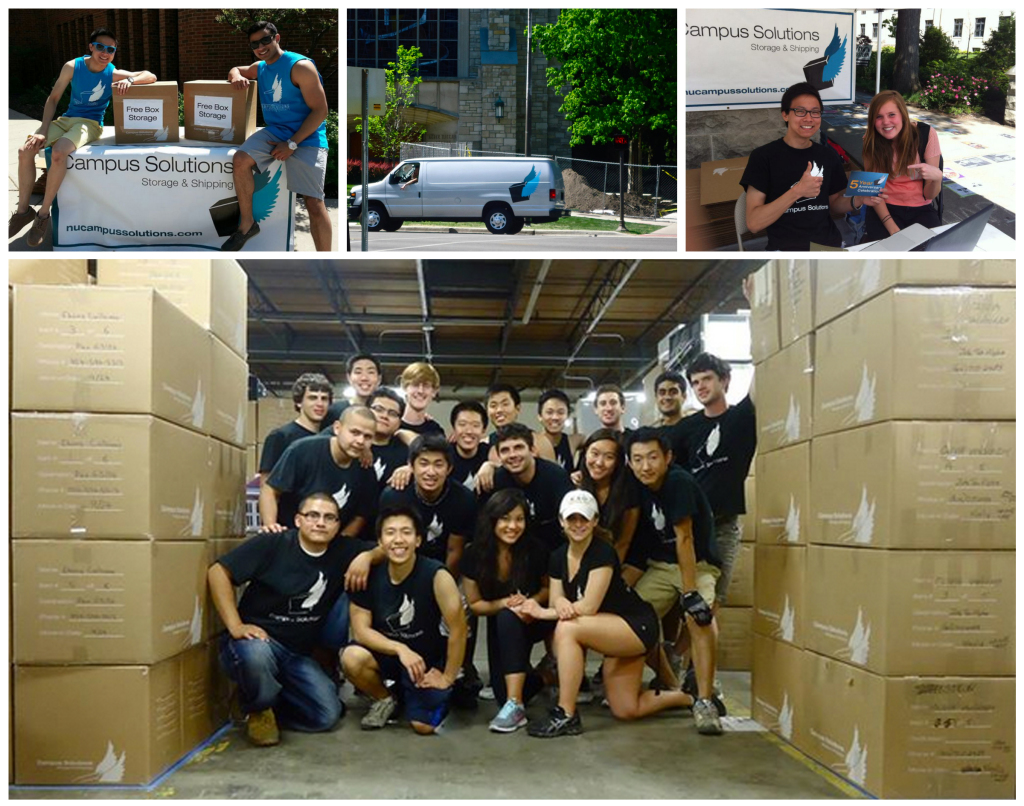
Before I arrived at Northwestern, I had my eyes on joining one organization: Campus Solutions (CS), a shipping and storage company run by students. To my eighteen-year-old self at the time, CS was the holy grail of business organizations. After all, it was the most successful student-run startup to date, generating at its peak a quarter million in revenue each year. It was in my eyes, the top organization at Northwestern if you wanted a great opportunity to ultimately graduate and enter the big world of business. Even more specifically: it was a great network if you wanted to enter investment banking, which like many eighteen-year-olds, I thought at the time was the job to have. While I may have been naiive in my reasons to want to join by taking a graduating senior who I had never met’s word for it (a guy named Harry who was a high school friend of one of my sister’s college friends) on Campus Solutions, joining CS taught me critical lessons that I still carry on today.
When I tell people I used to move boxes, they usually think I’m kidding. After all, I’m 5’9” (5’10” on a good day) and have never weighed more than 150 pounds in my life. But I did lift many boxes and I happily did it for two years of undergrad from 2011-2013. It was from Campus Solutions that I met some of the brightest people I’ve ever met at Northwestern; in fact, it was from CS that I first met Luke, my co-founder at Learnerator today. CS was a gathering of some the greatest young entrepreneurial minds I’ve ever met, and it should come to no surprise given the rigorous recruiting process to join.
The process emulated what college juniors go through for investment banking/consulting/trading internships every year. The difference though was that I was eighteen and a freshman right out of high school with limited interview experience. Needless to say, I was a bit intimidated but I knew I wanted to join CS. It was the place I had identified where I could grow and learn the most. And so I e-mailed a girl named Emily, who was an owner of the company, in the fall inquiring about recruitment and beginning the process.
I still remember my cover letter. Being your classic high school overachiever, I googled cover letter and crafted a letter to send with my resume for CS. The funniest part about my application was I totally name-dropped Harry in that letter, who I had actually never met in real life but just talked with via e-mail before I arrived at NU. I later heard about it from my sister that Harry got a good laugh about it when the CS team told him about it. Fortunately, it didn’t hurt, and after spending a few extra minutes talking with CS managers at the info session to make a solid first impression, I was invited for first round interviews. Reflecting on my application, this was when I first learned that you should always use good judgment when to mention you know someone; while I may have made a small err there, I also learned that setbacks when applying for jobs are natural, and even regardless of your mistakes, there’s always an opportunity to recover. This was a critical lesson I carried on when applying for summer internships my sophomore and junior year.
First rounds went well, I remember Dobs played hardball the entire way, but I felt confident that I had a solid shot at making it past the first round, and fortunately, I did. Superday had arrived and before I knew it, I went through another four or so rounds of interviews before ending the day with my fate up in the air. And then I got a call for another interview. This time it was at Evanston Place, and the CS team didn’t really give me a framework for what would be asked at that interview. I remember sitting in the apartment complex lobby with a future fellow manager and good friend, KC, at the time, who I hardly knew except from meeting him a few times from being in the same Math 230 class. We had no idea what was coming next, but since it was just us two and another person, I assumed we were the final three standing and only one or two of us was going to come out the other side. I remember relating with KC about how this was most extensive and borderline ridiculous process I’d ever gone through.
That was when Emily ushered us into a conference room on the first floor, where a few owners of the company like Ren, and at that time David, were sitting across the table like any classic movie scene of a business negotiation. The lights focused in on the center table in a relatively poorly lit room with three papers laid face down next to chairs we promptly sat in. Ren asked in his very classically straight face, “Do you know why you guys are here?” The three of us shook our heads. Ren then said, “Well after much deliberation, we would like to extend an offer to you to join our company. The papers in front of you are your offer sheets. Please review them, and let us know by Sunday if you will be accepting our offer.” The three of us tried to contain our excitement and just smiled, said thanks, but I think even then we knew the opportunity that just presented itself was a special one. This was when I learned that anticipation and uncertainty drives curiosity and buy-in, and if you do not truly make a “rushee” feel like they had to work for their spot in your organization, they will never be as committed to your organization as you’d like them to be. Walking back from Evanston Place that night, I felt a great sense of accomplishment for having made it; after all, applying to CS was like getting into a top school. In first rounds, we’d take the top candidates, then take the next top candidates in second rounds, before then making a final selection.
The next two years working with CS were incredibly educational for me. Some moments naturally tend to stick out more than others.
Every spring, we would help a thousand Northwestern students store their things for the summer. As you can imagine, it was incredibly hectic and on top of picking up these students’ things, it all happened during Reading Week and Finals Week. CS Managers were all fundamentally similar in the sense that they were incredibly driven, felt an innate need to provide an insanely excellent service, and innovative in the ways they built and operated the business.
Some days in the spring to promote ourselves, we’d have a free box day at the Arch and outside of Tech. It was a real crowd pleaser. It wouldn’t be uncommon to see several people walking down Sheridan with huge boxes in their hands. And while some may think this was a stupid business idea, it was brilliant. While we would have to absorb a hit of giving away a thousand boxes for a free box day, the promotion itself had virality written all over it. Those days were fun, as something I made sure to start doing was taking pictures featuring students with our boxes, which we would then post in albums on Facebook. It was from free box days that I learned a few critical lessons. First, sometimes giving away things for free seems counterintuitive to making money for a business, but doing so can actually fuel business—in this case on free box days we’d always experience spikes in student reservations made. Today at Learnerator, we give away 60% of our content for free, and it works incredibly well because it allows the consumer an opportunity to experience us for themselves before buying. Second, if you’re going to give away something for free, make sure you make the other person earn it in some way. In our case, we started having people like our Facebook page in return for boxes, making it a win-win for both parties as we saw higher social engagement. Third, the way you frame and assert your message can make the difference between catching someone’s attention and completely failing. If you only go 50% into your approach when presenting yourself or an offer to someone, you’re going to fail at catching someone’s attention at least 50% of the time. It was from free box days and other days tenting that I learned how to deliver a short enough message that could capture a person’s attention and hold it long enough for me to present the value I had for them that day. Framing is a lesson I still use every day when sharing our resources with different AP teachers and school contacts.
Operations weeks in fall and spring were the most grueling and rewarding of the year. During these weeks managers would clock around 80-100 hours on top of taking finals. It wouldn’t be uncommon to work starting early in the morning until midnight or even after midnight in the warehouse. To this day, CS operations weeks were some of the best workouts I’ve ever done. Being around 125 lbs my freshman year, I was the lightest male manager on the team so lifting boxes anywhere from 30-90 pounds on a daily basis for at least ten hours was the fastest way I’ve ever seen physical gains. I’ve never been so sore in my life, but it was also in these weeks that I noticed my core strength improved the most. I loved it. There’s something incredibly cathartic and relaxing about doing something so simple as moving boxes when you’re supposed to be high-strung about final exams. CS forced me to stay fit and to create a habit of fitness in my life year-round. I learned a lot of lessons from operations weeks. First, I learned to appreciate truly hard physical labor. I think it really builds a great deal of character to do a blue collar job at least once in your life. You gain a whole new level of appreciation for manual labor workers. Second, I learned that in times of deepest desperation when your arms are about to give out because you’ve been working all week and you’re on the first floor of XYZ sorority and need to make it to the fourth with twenty boxes to go where half are overweight (OW as we’d call it), you suck it up and just do it because you represent your organization, and the last thing you want to do is be dropping a cute girl’s things. Third and most importantly, I learned the value and importance of systems, something I’ve grown to enjoy learning more about. Operations weeks needed to run like well-oiled machines, otherwise you would get unhappy customers and unhappy coworkers. It was from these moments learning from more senior managers and owners like Ren and Joe that I learned how every little thing matters, even something as simple as how you stack your boxes (something rival companies never seemed to get quite right). Achieving optimal efficiency is not easy, and watching how the seniors worked was eye-opening because it showed me when things are done right, it’s truly something beautiful. Seeing a warehouse go from 0 boxes to 8,000 organized boxes in a week and vice versa in the fall is an incredibly empowering feeling that makes you realize when you find something of greater purpose to dedicate your time to, in this case providing a convenient and unparalleled service for stressed out NU students, it’s important to take a moment and reflect on the accomplishments you achieve together.
I still remember the first time I helped run a truck without a senior manager. It was with KC and it was around midway through operations week. We were a bit unsure of ourselves at first but quickly devised a system that worked well. Everything was smooth sailing throughout the day. We’d picked up many of our students’ things on our schedule, including a sombrero by a customer named Marcel. Everything was great until early in the afternoon when we accidentally grazed a righthand mirror of a student’s car. That mirror stood no chance against our 16” truck. KC and I knew we had screwed up. KC was naturally a bit more worried since he was the one driving at the time, but we both were pretty scared of the earful we would hear when we told Ren what happened. Surprisingly, Ren wasn’t mad; he just told KC accidents happen and that it happens to everyone. I can’t speak for KC, but what I learned from this was that true leadership is recognizing the emotional state of your employees and reacting appropriately when providing feedback to them. There would be several other moments in my time with CS when Ren and I would talk and he would give me helpful advice that provided a great deal of perspective I would not have been able to see otherwise. Ren was and remains one of the most perceptive leaders I’ve ever collaborated with. He never displays an immense amount of emotion, but when he is proud of you, you feel a great sense of accomplishment and you know when those moments happen. He may have been misunderstood or caused frustration amongst some managers at times, but he always had the organization’s interest first. It was from moments like these and from working with Ren that I learned what it meant to fully dedicate yourself to building something great.
I could go on about impactful moments from when I worked for CS, but it would linger for pages. Ultimately, we were a group united by cardboard and we ultimately became family. Even though there were many managers before me that I never had the chance of really getting to know as part of the company, whenever I come across one it’s as if there’s an unspoken bond shared between us. Perhaps the best example was how I met Luke. Luke started phasing out of the company in his senior year to start Learnerator and I had met him just once at a CS party at Bellen’s place. Even to the point in which Learnerator acquired College Creed, I had only interacted with Luke two or three times, once calling him for advice about how to start College Creed. Yet, the CS connection made the difference, because it was from us both having been part of Campus Solutions that we naturally identified that the other person was possibly a strong potential co-founder to work with. I actually remember asking Ren what Luke was like as a manager, because I wasn’t sure I really knew Luke well enough to join forces. Ultimately I decided to do it, and believe we make a formidable team at Learnerator. We have a ways to go as a company, but are headed in the right direction.
Whenever I think back at CS, I can’t help but think of Apple’s “Think Different” Campaign. The company really did do something differently at Northwestern ushering in a new trend I see now of student-run companies popping up on campus. We were the crazy ones to work 80-100 hour weeks during Finals weeks (and in some cases doing stupid things like ramming massive tubes into wooden palettes while sitting in rolly chairs, doing pullups on clearly unstable wooden beams, or hanging onto the back of the spoiler of the van while riding down Sheridan (remember that, Bellen?)). We were misfits, rebels, and troublemakers in that we kept a business completely independent from the university. We were round pegs in the square holes in the way we marketed to students (even to this day student groups use Nancy’s tagging contest idea for giveaways) and we saw things differently in the way service was provided to students. As I enter my last ten weeks at Northwestern, I will forever be grateful for having had the opportunity and experience to have been part of such a great team as we built something great, together.